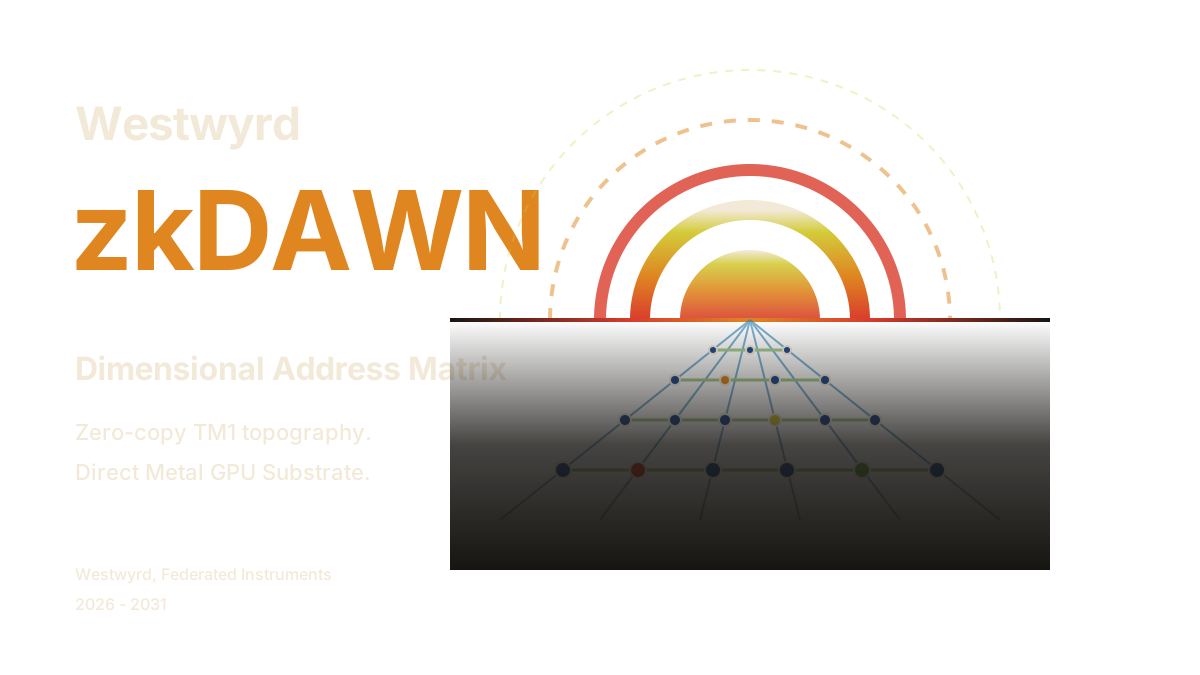
zkDAWN operates as a zero-copy, dimensional TM1 address matrix, establishing a fundamentally new relationship between computation and state. By bridging directly to the Apple Silicon Metal GPU, zkDAWN completely bypasses traditional buffering and serialization overheads, allowing the state array to evolve in continuous time without ever detaching from the substrate.
Instead of relying on rigid, discrete database transactions, the TM1 topography maps directly onto bare-metal execution pathways. Address locations project seamlessly into n-dimensional space, maintaining absolute topological coherence. Because the array operates without intermediate memory layers, state propagation incurs zero-copy latency, providing an incredibly fast environment for extreme-density institutional datasets.
Every coordinate within the zkDAWN matrix is mathematically bound to a STARK-provable ledger. As the matrix evolves across dimensional bounds, continuous-time zero-knowledge proofs compress the entire execution history into constant-time verifiable artifacts. This guarantees that an adversarial actor cannot mutate the dimensional fields without invalidating the entire topological history—absolute provenance, isolated strictly on-device.
Six capabilities, absolute topology.
Native Metal Substrate
Bridging directly to the Apple Silicon GPU, zkDAWN eliminates middle-tier latency entirely. Render paths operate directly on bare-metal architecture, bypassing traditional OS-level bottlenecks and enabling absolute hardware efficiency for institutional-grade scaling operations.
Instead of traversing through abstraction layers like Kubernetes, Docker networking, or traditional hypervisors, the Native Metal Substrate hooks directly into the underlying Unified Memory Architecture (UMA) of the M-Series chips. This fundamentally rewires the computational paradigm, allowing state transitions to happen as fast as electrons move through silicon, fully exploiting the 800GB/s memory bandwidth available on top-tier Apple Silicon.
By executing strictly within the physical boundaries of the device, data residency is absolute. The matrix operates entirely in an air-gapped or localized context while continuously broadcasting cryptographic proofs of its own integrity, merging massive parallel processing power with strict sovereign data custody principles.
Zero-Copy Address Matrix
State arrays propagate through the dimensional matrix without a single instance of buffering or serialization. Address pointers remain intact and contiguous from end to end, meaning complex transformations execute exactly where they sit in memory without expensive copy operations.
In standard database architectures, transferring state between computation and storage requires serialization (JSON, Protobuf) or network hops (gRPC). The Zero-Copy Address Matrix avoids all of this by mapping the continuous TM1 structure into a shared memory buffer. When the matrix shifts, the data doesn't move; only the topological relationship of the pointers is recalculated.
This allows zkDAWN to maintain millions of nodes per frame without incurring the catastrophic garbage collection pauses or heap fragmentation that plague conventional data engineering pipelines. It establishes a perfectly frictionless environment where dense, highly interconnected market or scientific graphs can evolve instantly with zero mathematical separation.
Dimensional Topography
Address locations map seamlessly to n-dimensional space instead of flat tables. The TM1 array maintains complex topological relationships intrinsically. This completely removes the need for synthetic structural mappings, enabling immediate coordinate lookups and instantaneous traversal across deep dimensional bounds.
Traditional databases force a 2D constraint onto multi-dimensional realities, requiring expensive JOINs and index scans to reconstruct spatial or hierarchical context. zkDAWN’s topography natively respects the true shape of the data. Whether you are mapping complex derivatives structures, global logistics supply chains, or multi-agent sovereign interactions, the matrix natively holds the physical topography of the data.
Because the dimensional topography is mapped into a continuous array, pathfinding algorithms and traversal calculations can be executed natively in constant time. The GPU parallelizes these operations, enabling instantaneous querying across billions of connected points without degrading the zero-copy integrity of the state.
Ledger-Backed Pointers
Every single coordinate inside the TM1 address matrix maps cryptographically to the main state ledger. While running in a zero-copy environment, it doesn't sacrifice provenance; it hard-codes it into the very pointers of the array, ensuring structural validation at the lowest level.
Each memory address is tethered to a Poseidon hash root. When the address updates, its corresponding leaf on the append-only ledger increments perfectly in sync. This means that a memory pointer in zkDAWN is not just a computational artifact, but a mathematically irrefutable proof of existence within the specific timeframe.
For institutional environments such as clearing houses, high-frequency settlement channels, or classified intelligence environments, this guarantees that memory state can never be retroactively altered, corrupted by cosmic rays, or maliciously intercepted by unauthorized hypervisor-level interference without instantly breaking the continuity of the ledger itself.
Continuous-Time Evolution
By completely eliminating discrete rendering steps and buffered state changes, the matrix evolves in continuous time rather than distinct chunks. State verification matches execution frame-for-frame, providing zero-separation attestation where computation and proof exist simultaneously.
Most systems operate on a tick-based or block-based paradigm—state is buffered, locked, executed, and committed. zkDAWN’s continuous-time evolution operates entirely differently. Because there are no copy operations and no locking contention, the matrix is effectively a liquid state that is evaluated as a continuum rather than isolated frames.
This allows for the execution of temporal algorithms and continuous-time quantum walks directly on the topology. It enables the system to track real-world phenomena, high-velocity liquidity flows, and complex network interactions exactly as they happen in reality—without arbitrary chronological fragmentation or delayed finality.
STARK-Verified Horizons
Continuous proofs mathematically bind the matrix topology to an exact moment. Adversaries cannot mutate the address fields or corrupt the dimensional structure, as STARK proofs verify the entire continuum of the array execution into an immutable, constant-time verifiable horizon.
Using advanced ZK-SNARK and STARK circuits, the Apple Silicon engine continually "folds" the active memory array into a zero-knowledge cryptographic proof. This process distills billions of topological coordinates and continuous-time memory operations into a single cryptographic string that any third party can verify without downloading the raw dataset.
The result is absolute trust. A client, regulator, or partner can verify that the dimensional TM1 matrix ran flawlessly according to its defined ruleset, without exposing the highly sensitive internal coordinate data or requiring access to the physical Apple Silicon hardware itself. It establishes zero-trust institutional operations over local, private execution environments.
The engine behind
dimensional truth.
zkDAWN fundamentally changes the relationship between computation and state. Instead of relying on buffered memory layers, zkDAWN bridges directly to the Apple Silicon GPU to form a zero-copy dimensional TM1 address matrix. By allowing the entire operation to run natively on M-Series architecture, data never incurs serialization latency. It provides absolute data residency and topological precision, while the continuous states can be bound mathematically to an immutable STARK proof.
Local on-device execution — zkDAWN runs natively on your Apple Silicon, not in a Kubernetes pod, ensuring absolute data residency.
Zero-copy memory fields — eliminates serialization delays by maintaining a continuous TM1 address matrix directly on the Metal GPU.
Continuous-time evolution — state verification happens simultaneously with execution without discrete buffering steps.
Cryptographic bindings — every node in the dimensional array maps securely to an append-only provenance ledger.
STARK zero-knowledge proofs — compress the entire matrix execution state into a constant-time verifiable artifact.
zkDAWN fundamentally changes the relationship between computation and state. Instead of relying on buffered memory layers, zkDAWN bridges directly to the Apple Silicon GPU to form a zero-copy dimensional TM1 address matrix. By allowing the entire operation to run natively on M-Series architecture, data never incurs serialization latency — it provides absolute data residency and topological precision, while continuous states can be bound mathematically to an immutable STARK proof.
Local On-Device Execution
zkDAWN runs natively on your Apple Silicon — not inside a Kubernetes pod, not in a cloud enclave. The application is never abstracted from the hardware it runs on. This means the proving pipeline starts and ends on the same physical silicon, with no network handoff for state.
Zero-Copy Memory Fields
Eliminates serialization delays by maintaining a continuous TM1 address matrix directly on the Metal GPU. Data is never buffered into an intermediate representation — pointers ARE the state. The GPU consumes these pointers natively as rendering descriptors.
Continuous-Time Evolution
State verification happens simultaneously with execution. There are no discrete buffering steps, no batch windows, no flush operations. The matrix evolves continuously, and the cryptographic commitment tracks the evolution in real time.
Cryptographic Bindings
Every node in the dimensional array maps securely to an append-only provenance ledger. The chain of custody is mathematically enforced, not asserted. Every login, verify, prove, provision, and rate-limit event is appended — same discipline as the WYRD protocol.
STARK Zero-Knowledge Proofs
Compress the entire matrix execution state into a constant-time verifiable artifact. Proof size is independent of computation depth. The prover-service is the only component that requires horizontal scale — all other services are stateless and trivially cheap.
Enclave Bridge Gating
The enclave prover address is never public. The bridge is the only caller — clients never learn where proving runs. Three identity sources (WorkOS user, wallet seat, access token) resolve to a single subject carrying tier-bound limits that the bridge enforces before any job reaches the prover.
zkDAWN native layer → proving backplane → verifier / ledger
zkDAWN Layer
On-Device / NativeOne boundary governs the whole design: zkDAWN is a native Apple-silicon application, not a container. It renders on the Metal GPU and does on-device proving. It runs on operator machines or dedicated Mac hardware — never in a Kubernetes pod. What it emits (PFM captures, formation roots) is what enters the service plane.
Proving Backplane
ContainerizableThe prover, verifier, bridge, and gating services are stateless-or-ledger-backed processes that fit cleanly into containers. "Deploy on k8s" applies to the backplane, not to zkDAWN. The two meet at a queue: zkDAWN drops a capture + spec; the prover service picks it up. Bridge and verify nodes run as 2–3 replicas behind the ingress — stateless and cheap.
Prover Service
Kubernetes HPAOnly the prover-service genuinely needs Kubernetes. Proving is the expensive, embarrassingly-parallel step. It operates as a Deployment with an HPA keyed on queue depth — each pod pulls one job (capture + spec) from the queue (NATS/SQS/Redis), runs the STARK, writes the proof + receipt, and acks. Scale pods with backlog.
WorkOS AuthKit — SSO/SAML, sessions
State: None (WorkOS holds it)
Stateless · trivial
Single public door to proving. Routes verify/prove, enforces role, tier, rate limit, and logs.
State: Append-only ledger
Stateless front, shared ledger
Identity → tier → entitlements (credits + rpm). Auto-provisions on payment.
State: Subscriptions + rate windows
Stateless logic over shared store
Runs the STARK. The expensive, embarrassingly-parallel, GPU/CPU-bound step.
State: Job in / proof out
Kubernetes HPA — the autoscale target
Recomputes hash vs committed root. Free, read-only, publicly accessible.
State: None
Horizontal · trivial
Append-only provenance store. The audit log for every proving event.
State: The record
Single-writer, replicated read
Three identity sources (WorkOS user, wallet seat, access token) resolve to a single subject key. The subject carries a tier; the tier carries machine limits the bridge enforces before any job reaches the prover. Verify is free for any valid subject. Prove requires canProve, an available credit, and passage of the rate limit — all three checked at the bridge.
Proof artifacts are ephemeral. Computation occurs inside an isolated runtime and the output is returned to the caller. No state is retained on the proving infrastructure after the job completes.
Your proving environment is provisioned exclusively for your workload. The backplane does not share queue workers, ledger partitions, or compute across tenants at this tier.
Data never leaves your zkDAWN instance. Absolute on-device residency — the default for sovereign operators. Enterprise on-prem runs the entire backplane in the customer's own cluster.
To achieve latency-free dimensional rendering on the Apple Silicon GPU, the traditional CPU-to-GPU data buffer protocol is dismantled entirely. The continuous state of the STARK proving engine writes directly into the TM1 dimensional matrix space using a zero-copy pointer mapping. The Metal GPU reads these pointers natively as rendering descriptors, visualizing the mathematical geometry of the execution trace precisely at the clock cycle of state transition — no intermediate copy, no flush, no lag.
What it does, in the field.
Dimensional Topology Mapping
Project complex state changes directly into the native TM1 matrix without memory penalties. zkDAWN translates vast data topographies directly through Apple Silicon.
Continuous-Time Ledger Attestation
Bind the moving matrix coordinates to cryptographic proofs at the exact moment of execution. Establish an unbroken, mathematically irrefutable chain of matrix custody.
Air-Gapped High-Frequency State Tracking
For institutions mapping extreme-density environments, local execution on dedicated Macs guarantees data never leaves the enclave while still providing global proofs of integrity.
Instance Size vs. Performance
Comparing traditional Hyper-Heuristic job shop scheduling operations (Adding, Removing, Shuffling) against the zkDAWN zero-copy dimensional matrix.
zkDAWN (Dimensional Matrix)
→ Zero-copy pointers map heuristic rules instantly.
→ Instance size scaling has zero impact on memory bounds.
→ STARK generation wraps pointer topologies directly.
The Known (Traditional Heuristics)
→ Memory copying required for every rule permutation.
→ Instance size directly inflates job shop scheduling latency.
→ State finality is delayed by array mutation locks.
Native Interfaces
Establish a zero-copy shared memory pointer between the client process and the NativeDAWN Metal GPU substrate.
struct MatrixCoord {
  uint64_t tm1_root;
  void* metal_buffer_ptr;
}Trigger a continuous-time STARK fold on the current address matrix topography.
// Returns the Poseidon hash shard of the local matrix state
let proof = await zkdawn.fold(tm1_root);Enter the Matrix
zkDAWN provides the zero-copy substrate to establish absolute provenance for dimensional topologies. Contact our institutional team to scope an enterprise deployment or request an Apple Silicon native license.